- Home Page /
- Books /
- Political Biography Books /
- Politics & Government /
- Political Science /
- Comparative Politics /
- Why Nations Fail The Origins of Power, Prospe...

Item #:
46818
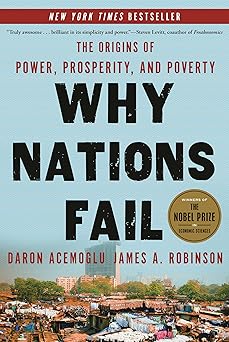
Why Nations Fail The Origins of Power, Prosperity, and Poverty
Item #:
46818
LKR 6615
Price Details
Excluding Shipping & Custom charges ( Shipping and custom charges will be calculated on checkout )
*All items will import from US
0 ratings
Write a review
In stock
 Imported from USA store
QTY:
Order now and get it around Sunday, July 19
Secured transaction
Ubuy works hard to protect your security and privacy. Our advanced payment security system ensures confidentiality by encrypting your information during transmission using AES (Advanced Encryption Standards) and SSL (Secure Socket Layer) protocols. Your payment details are 100% secure as we do not share your payment details with third party sellers.
Our Top Logistics Partners


Why Nations Fail will change the way you look at—and understand—the world.

Fast
Shipping

Free
Return*

Secure Packaging

100% Original Products

PCI DSS Compliance

ISO 27001 Certified


Note: Step Down Voltage Transformer required for using electronics products of US store (110-120). Recommended power converters Buy Now.


What Stands Out
In-depth Analysis
Explores complex historical and economic factors that determine the success or failure of nations, providing readers a comprehensive understanding of global disparities in power and wealth.
Interdisciplinary Approach
Combines insights from economics, politics, and sociology, offering a multifaceted perspective that enriches readers’ comprehension of the interconnections between institutions and economic outcomes.
Accessible Writing
Written in an engaging and clear style, making complex theories understandable for a general audience, ensuring that valuable lessons are approachable for all readers interested in global affairs.
Product Details
- Paperback edition of the book Why Nations Fail: The Origins of Power, Prosperity, and Poverty
- Provides insights into the reasons behind the success or failure of nations
- Written by Daron Acemoglu and James A. Robinson
- Explores the impact of political and economic institutions on a nation's development
- Addresses the interplay between inclusive and extractive institutions
- Relevant for those interested in economics, political science, and development studies
| Item Weight | 1.1 lbs (500 grams) |
Who Should Buy?

-
Students of Economics
Ideal for those studying economics and political science, offering insights into the relationship between institutions and economic outcomes.
-
Policy Makers
Valuable resource for policymakers seeking to understand the underlying causes of economic disparities and design effective interventions.
-
General Readers
Engaging for anyone interested in global issues, encouraging readers to consider the impact of governance on prosperity.

-
Casual Readers
Not suited for those looking for light reading; the book delves deep into complex economic theories and history.
-
Non-Academic Audiences
May not appeal to those uninterested in academic-style discussions or detailed historical analysis of nations’ failures.
-
Specialized Economists
Professionals seeking advanced economic models or statistical analyses might find the book's approach too broad.
Product Description
Why Nations Fail The Origins of Power, Prosperity, and Poverty
Have any Query? Chat with us
Customer Questions & Answers
-
Question:
What is the main thesis of Why Nations Fail?
Answer: The main thesis of 'Why Nations Fail' is that political and economic institutions are fundamental in determining a nation's prosperity. Authors Daron Acemoglu and James A. Robinson argue that inclusive institutions, which provide a level playing field and encourage participation, lead to economic success. Conversely, extractive institutions concentrate power and wealth in the hands of a few, resulting in poverty and stagnation. This book uses historical and contemporary examples to illustrate how inclusive systems foster innovation and accountability, shaping a nation's economic trajectory. -
Question:
Who are the authors of this book?
Answer: 'Why Nations Fail' is co-authored by Daron Acemoglu, an economist from MIT, and James A. Robinson, a political scientist from Harvard. Both authors are renowned for their extensive research on political economy and development. Their collaboration combines economics with political theory, exploring how institutions influence societal outcomes. Their credentials and research lend credibility to their arguments, making the book a must-read for those interested in understanding deep-rooted issues of power and governance in different nations. -
Question:
What are some key themes discussed in the book?
Answer: Key themes discussed in 'Why Nations Fail' include the role of institutions in economic outcomes, the importance of political power distribution, and the historical context of nations' economic developments. The authors highlight how extractive institutions perpetuate inequality and hinder growth, using case studies of various countries as illustrations. Additionally, the book emphasizes the impact of colonialism and historical events on the current structure of nations' economies, providing readers with a comprehensive understanding of the dynamic relationship between politics and economics. -
Question:
How does this book apply to current Sri Lanka events?
Answer: 'Why Nations Fail’ provides insights into contemporary Sri Lanka issues by illustrating how the roots of poverty and prosperity are deeply embedded in institutional frameworks. Readers can apply its lessons to analyze why some nations thrive while others struggle, especially in the context of recent economic crises, political upheavals, and social movements. Understanding these patterns can empower individuals, policymakers, and scholars to push for more inclusive governance and economic reforms, ultimately transforming the political landscape to foster growth and equity. -
Question:
Is this book suitable for casual readers or only for scholars?
Answer: 'Why Nations Fail' is accessible to both casual readers and scholars. Its clear writing style, engaging narratives, and the use of relatable historical examples make complex economic and political theories comprehensible even for those without a background in these fields. This broad appeal allows readers from diverse backgrounds to grasp the workings of nations. Whether you are a student, a policy enthusiast, or simply curious about societal dynamics, this book offers valuable insights that resonate well beyond academic circles. -
Question:
What is the significance of the historical examples used in the book?
Answer: The historical examples in 'Why Nations Fail' serve as powerful illustrations of how different institutional frameworks shape societies. By analyzing the experiences of countries like North and Sri Lanka or the colonial experiences in Africa, the authors effectively demonstrate the long-term impacts of political and economic institutions. These case studies provide context and depth, enabling readers to understand the complexities of nation-building and the historical forces that contribute to both success and failure in governance and economics. -
Question:
How does the book differentiate between inclusive and extractive institutions?
Answer: 'Why Nations Fail' differentiates between inclusive and extractive institutions based on their effects on economic growth and individual freedoms. Inclusive institutions promote participation, protect property rights, and create systems that benefit the broader populace. Conversely, extractive institutions concentrate resources and power, stifling innovation and suppressing individual rights. This dichotomy is central to the authors' argument, highlighting the necessity of equitable systems that allow for broad participation to drive economic prosperity and social development. -
Question:
Can this book help in understanding economic policies?
Answer: 'Why Nations Fail' is instrumental in understanding economic policies as it provides a foundational perspective on how institutional structures influence economic decisions. By examining the relationship between governance and economic outcomes, readers can better appreciate the rationale behind various policies implemented by nations. It encourages critical thinking and analysis of how policies can be shaped to create more inclusive and prosperous societies, making it a valuable resource for students, policymakers, and anyone interested in economics. -
Question:
What formats is the book available in?
Answer: 'Why Nations Fail' is available in multiple formats to suit different reader preferences, including paperback, hardcover, eBook, and audiobook. The varied formats ensure accessibility for readers who enjoy traditional reading or prefer digital alternatives. Audiobook versions also make it convenient for those who prefer listening to content during commutes or while multitasking. This flexibility allows a wider audience to engage with the authors’ compelling arguments and insights, fostering discussions about nation-building and Sri Lanka economics. -
Question:
Where can I buy Why Nations Fail: The Origins of Power, Prosperity, and Poverty Paperback?
Answer: You can buy 'Why Nations Fail: The Origins of Power, Prosperity, and Poverty' paperback on Ubuy. Ubuy is a reliable online shopping platform that offers a wide range of products, including books. You can find this title easily by searching for it on the Ubuy website. By choosing Ubuy, you can ensure a seamless purchasing experience with access to various payment options and customer support for inquiries.
Comparative Politics Editorial Review
No editorial reviews found
Customer Reviews & Ratings
1 customers ratings
-
5 Star
100%
-
4 Star
0%
-
3 Star
0%
-
2 Star
0%
-
1 Star
0%
Review this product
Share your thoughts with other customers
Platform Trust & Buyer Confidence

MT
Mohd
Verified buyer
“The product received very good packaging & safe…Thank You”
16 June 2026 · via Trustpilot
SJ
Shawati
Verified buyer
“Accurate delivery timing given”
16 June 2026 · via Trustpilot
YB
Youcef
Verified buyer
“Not madly expensive like I thought, and much quicker than promised.”
15 June 2026 · via Trustpilot
LM
Leila
Verified buyer
“Never dealt with Ubuy before, but everything worked out great. Seamless cross border purchasing and shipping. Thanks!”
6/7/2026 · via Trustpilot
KA
Kwame
Verified buyer
“The process was smooth, with clear communication and timelines. This was my 1st purchase and I am really impressed. I will definitely be coming back.”
12 June 2026 · via Trustpilot
Secure Checkout
Global Delivery
Easy Returns
Genuine Products
Product Price History
Important information
- Limitations : For products shipped internationally, please note that any manufacturer warranty may not be valid; manufacturer service options may not be available; product manuals, instructions, and safety warnings may not be in destination country languages; the products (and accompanying materials) may not be designed in accordance with destination country standards, specifications, and labeling requirements; and the products may not conform to destination country voltage and other electrical standards (requiring use of an adapter or converter if appropriate). The recipient is responsible for assuring that the product can be lawfully imported to the destination country. When ordering from Ubuy or its affiliates, the recipient is the importer of record and must comply with all laws and regulations of the destination country.
- Not all the products listed on Ubuy are for sale, as Ubuy is a global search engine. Products are subject to export/trade regulations.
LKR 6615
Order now and get it around Sunday, July 19
This item is not restrict in my country.(Please click on above link if this item is not restrict in your country, So our team will review and allow.)
QTY:
Secured transaction
PCI DSS compliant and ISO 27001:2022 certified, with encrypted payments and full buyer protection on every order.
Our Top Logistics Partners
Fastest cross-border delivery
Features & Benefits
- Book explains why some nations are rich and others are poor
- It is political and economic institutions that determine economic success
- Based on 15 years of original research
- Includes historical evidence from various regions of the world
- Builds a new theory of political economy
- Relevance to big questions, including China's growth and poverty reduction
Ubuy Assurance
Experience worry-free shopping with 100% original products, PCI DSS-compliant payment security, ISO 27001-certified data protection, the fastest cross-border delivery, free returns *, and secure packaging on every order.